Compendium › Breathwork › Functional patterns
The Physiological Sigh
Two inhales through the nose — a full one, then a short top-up — followed by a long, unhurried exhale through the mouth. The body already does this on its own; here it is done on purpose.

AI-generated demonstration image.
How it's practiced
- Sit or stand comfortably. Let the shoulders be heavy.

- Inhale through the nose until the lungs feel comfortably full.

- Without exhaling, take one more short sip of air through the nose — a small top-up at the top.

- Exhale slowly through the mouth, longer than the inhale, letting the air leave on its own schedule.

- That is one cycle. One to three cycles is a complete practice; there is no need for more in one sitting.
Breath
Double nasal inhale, extended oral exhale. Keep everything at comfortable volumes — this is a sigh, not a gasp.
Variations
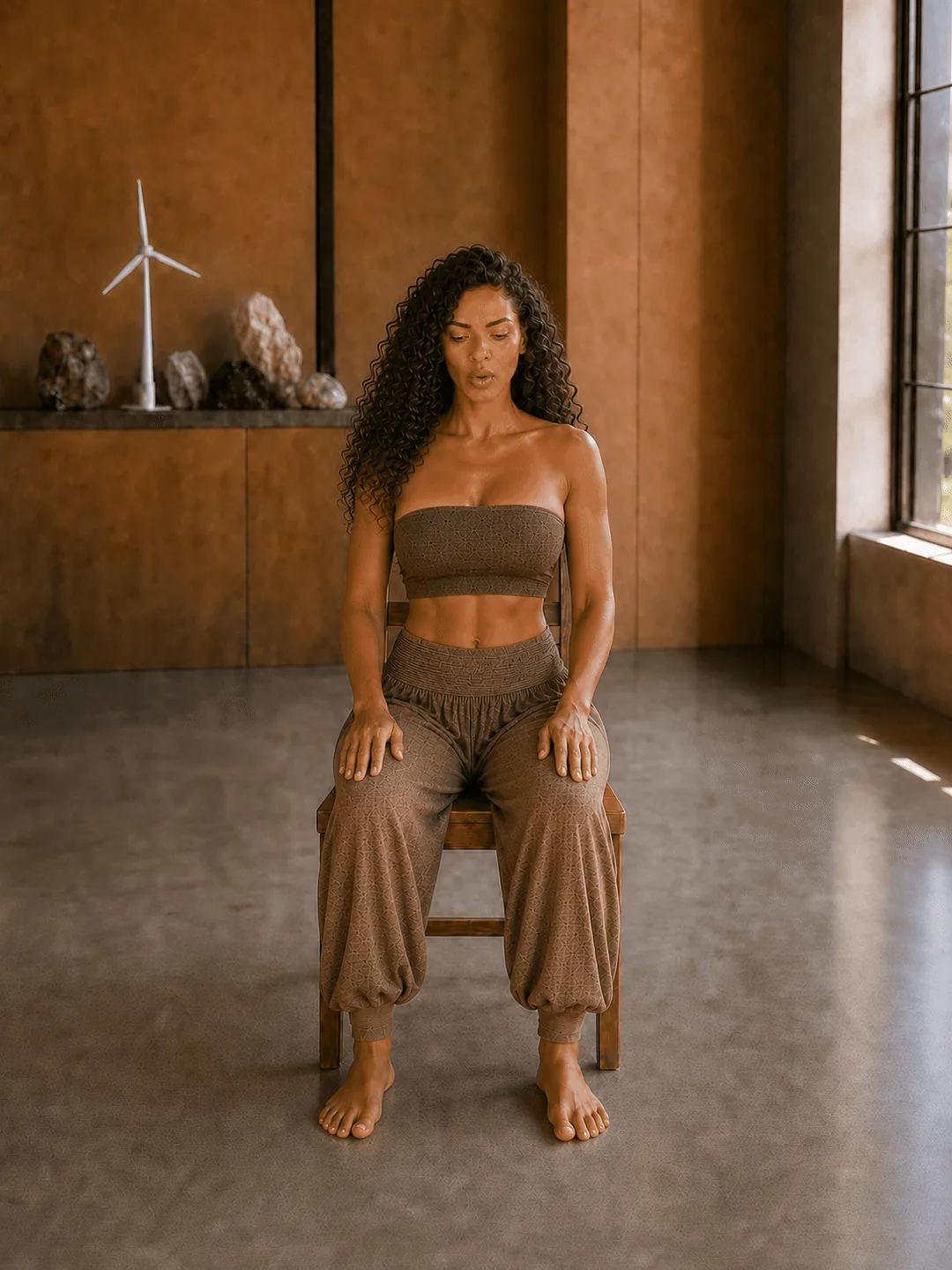
Seated Chair
Identical seated; this pattern is position-independent.
Low Range
Single comfortable inhale with a lengthened exhale — same shape, smaller dose.
How hard is it, honestly?
These two numbers are close — the practice is honestly what it appears to be.
What's happening in the body — and why
The double inhale reinflates small air sacs that quietly collapse over a long sitting day, and the long exhale is the part that matters for settling — extending the out-breath relative to the in-breath is associated with a shift toward the body's rest-and-digest state. Your body already does this spontaneously every few minutes. Here you simply take the wheel.
Regions most involved. Original diagram — schematic, not anatomical reference.
Muscles
- KINESIOLOGYDiaphragm and external intercostals drive the two-stage inhale; the second sip further expands already-opened lung regions.
- KINESIOLOGYThe long exhale is largely passive elastic recoil, with gentle abdominal assistance at the end.
Joints & skeleton
- KINESIOLOGYRibs expand and settle; no other joints need participate.
- KINESIOLOGYSitting or standing tall gives the ribs room to move.
Traditional organ framework
- —
Traditional energetic framework
- —
What you might notice
Newer or limited mobility
EXPERIENCEFully accessible in any position, including lying down. If the double inhale feels awkward at first, a single full inhale with a long exhale is a fine variation.
Moderate experience
EXPERIENCEMany people notice a distinct downshift — shoulders dropping, exhale lengthening on its own — within one to three cycles. Responses vary.
Experienced
EXPERIENCENotice the moment the exhale becomes genuinely passive, and how little effort the whole pattern actually needs.
Stop signals
- dizziness or tingling — return to normal breathing and let it pass
- any chest pain or unusual shortness of breath: stop and seek appropriate medical help
- if breathwork reliably triggers anxiety, practice with professional guidance
Effects over time
Right away
EVIDENCEControlled studies of deliberate sighing patterns report short-term reductions in self-reported arousal/stress compared with some other breathing patterns; effects are modest and individual. [EXPERIENCE] Commonly felt as rapid settling.
Weeks
EXPERIENCEWith practice, the pattern becomes available quickly in stressful moments. Research on long-term daily use is limited.
Months
EVIDENCELong-term outcome research specific to this pattern is limited; no claims made.
Recovery
None needed. If lightheadedness appears, do fewer cycles.
Timing & rhythm
- Time of day: PRACTICALAny moment that needs a downshift — between meetings, after difficult news, before sleep.
- Food: PRACTICALUnaffected by meals.
- Frequency: One to three cycles, as needed through the day.
Pairings
Combos with compounding effect
- qigong.baduanjin.two-hands-hold-up-the-heavens, qigong.baduanjin.wise-owl-gazes-backwards — The desk-reset stack: lengthen, glance behind, sigh — a complete downshift in under three minutes.
Strength pairings
- —
Stretch pairings
- Pairs naturally before any stretch — tissue lets go more easily after the exhale.
Everyday life
The body issues these sighs unprompted about every five minutes. Once an hour, beat it to the punch.
Contemplative pairing
Practice phrase: CANONOriginal Yarra practice phrase: Two breaths in for what is; one long breath out for what was.
Meditation pairing: A fine doorway into sitting practice — sigh once, then follow the ordinary breath.
Take care
- respiratory or cardiac conditions → professional guidance for any breath practice
- panic-prone → keep doses tiny; stop at discomfort
- never practice breathwork while driving if it makes you drowsy, or in water
Sources & further study
What this page is built on
- Peer-reviewed research on cyclic sighing / deliberate sigh breathing and short-term stress measures (cite specific trials at page build)
Follow it further
- EVIDENCECyclic sighing research on PubMed
- REFERENCENCCIH: relaxation and mind-body approaches (public domain)
Images on this page are original to this site. We do not republish third-party instructional photography; where another source is useful, we link to it rather than copy it. See our sources & images policy.
Your practice
Stored only in this browser. Mindful repetitions count; rushing doesn't. Optional goal — not a health target.